
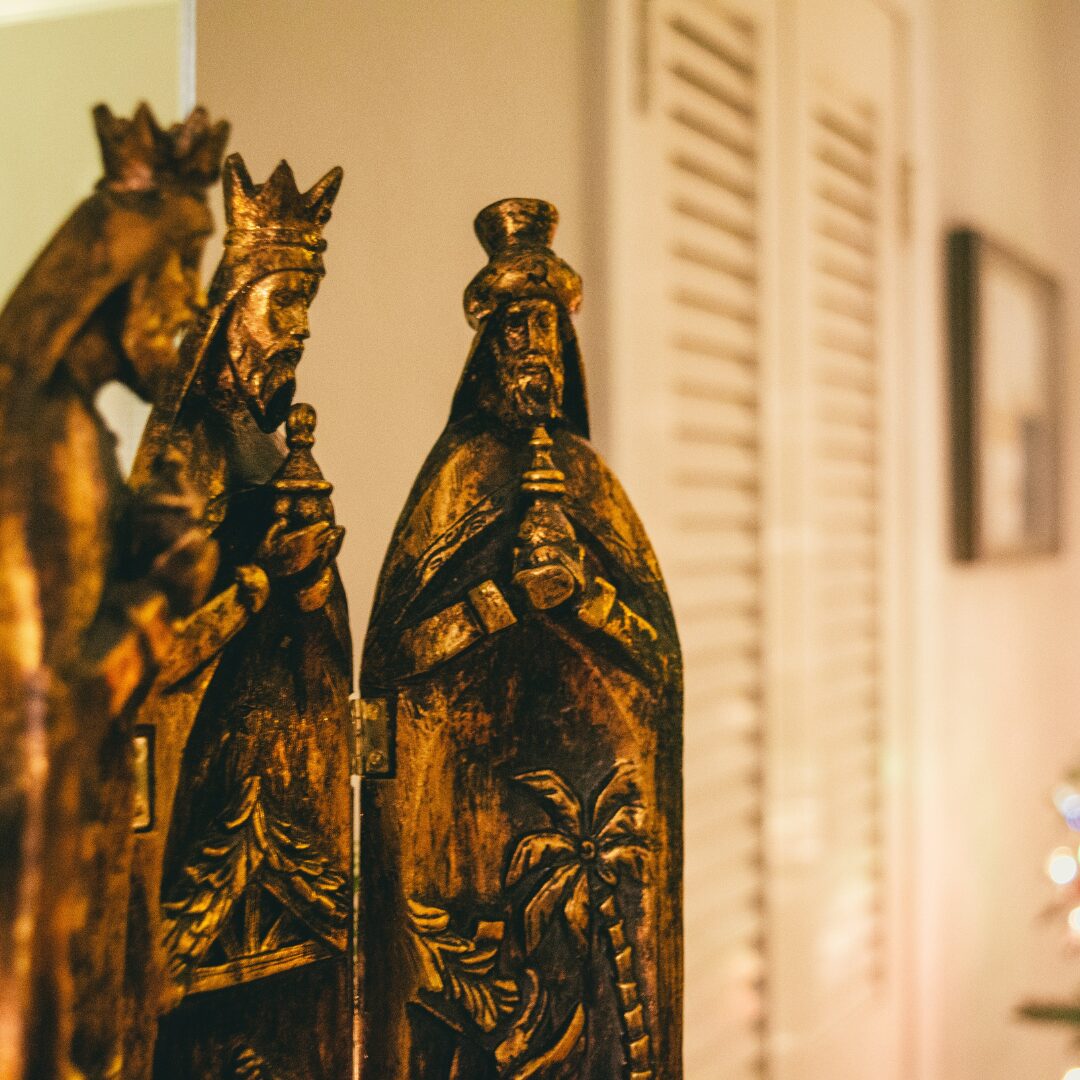
Matthew 2:1-12
A BETTER KING, A BETTER STAR, A BETTER GIFT | Epiphany | 06.01.2026 | Matthew 2:1-12 | Paul Bieber |
Matthew 2:1-12 Revised Standard Version
2 When Jesus was born in Bethlehem of Judea in the days of Herod the king, behold, wise men from the East came to Jerusalem, saying, 2 “Where is he who has been born king of the Jews? For we have seen his star in the East, and have come to worship him.” 3 When Herod the king heard this, he was troubled, and all Jerusalem with him; 4 and assembling all the chief priests and scribes of the people, he inquired of them where the Christ was to be born. 5 They told him, “In Bethlehem of Judea; for so it is written by the prophet:
6 ‘And you, O Bethlehem, in the land of Judah,
are by no means least among the rulers of Judah;
for from you shall come a ruler
who will govern my people Israel.’”
7 Then Herod summoned the wise men secretly and ascertained from them what time the star appeared; 8 and he sent them to Bethlehem, saying, “Go and search diligently for the child, and when you have found him bring me word, that I too may come and worship him.” 9 When they had heard the king they went their way; and lo, the star which they had seen in the East went before them, till it came to rest over the place where the child was. 10 When they saw the star, they rejoiced exceedingly with great joy; 11 and going into the house they saw the child with Mary his mother, and they fell down and worshiped him. Then, opening their treasures, they offered him gifts, gold and frankincense and myrrh. 12 And being warned in a dream not to return to Herod, they departed to their own country by another way.
also
Isaiah 60.1-6
Psalm 72:1-7, 10-14
Ephesians 3:1-12
A BETTER KING, A BETTER STAR, A BETTER GIFT
Grace, peace, and much joy to you, people of God.
Wise men from the East, Magi, are journeying as our Gospel begins. “Magi,” like magicians, are astrologers, soothsayers, court advisors to the kings of Babylon and later Persia, as in the time of Daniel. The early Church read Matthew’s story of the Magi together with Psalm 72 and concluded that the court advisors were really kings themselves. What was the star they saw and followed? Their astrological lore connected unusual appearances in the heavens with significant occurrences on earth. We can only conjecture about the star—and conjectures abound—but whatever these stargazers saw, it was meaningful enough to send them on a long and arduous journey. The reason they offer for their journey reveals that the king they seek is something more: they come to worship him!
So far Matthew has only set the scene for Jesus’ story, giving his genealogy from Abraham to Joseph, the husband of Mary, his mother, and the story of Joseph’s first dream, in which he is told not to be afraid: Mary’s child will be the fulfillment of ancient prophecy. So these exotic visitors from the East are a beginning, a first indication of what St. Paul writes in Ephesians, that the mystery of Christ, made known in a revelation, an epiphany, means that the nations, “the Gentiles,” have become fellow heirs with Israel, sharers in the promise of Christ Jesus, the Savior of the nations, through the gospel.
Indeed they—we—have been made members of the same body of Christ, which comprises both Jesus’ own people, tracing back their lineage with him through the fourteen generations back to the exile to Babylon, and the fourteen generations before that, back to David, and the fourteen generations before that, back to Abraham, through whom all the families of the earth are to be blessed—and also disciples from all the other nations, as Jesus says at the end of St. Matthew’s Gospel, in what we know as the Great Commission. All are fellow heirs, members of the same body, sharers in the promise.
The promise, that is, in Christ Jesus through the gospel. The earliest Church found that gospel promise—before the four Gospels were written—in Israel’s scriptures, like Psalm 72. This is a Psalm of Solomon, David’s son, king of Israel—but also a song of the king for whom the wise men were searching, the king of a very different kingdom: the embodiment of God’s mystery, like a seed sprouting, bread rising, a treasure found, a precious pearl acquired. The intent of this kingdom is the reconciliation of lost, broken humanity with our God.
There is another, very different king in this story: Herod, an Idumean; that is, an Edomite, named king of Judea in 40 B.C. by the Roman Senate—as foreign a king as Caspar, Melchior, and Balthasar (the royal names given to the Magi by the Venerable Bede in the eighth century). Herod’s concern, like that of every sinful self, is securing his own life, maintaining the illusion of control. For him, that means preserving his own throne. He will go to any lengths: he drowned his sixteen-year-old brother-in-law, the high priest. He killed his uncle, aunt, and mother-in-law, as well as two of his sons and three hundred officials he accused of siding with them against him. His professed desire to come and worship is rank hypocrisy. His preoccupation is power, political power.
Quite a contrast of kings: The wise men represent earthly wise men and rulers at their best—seeking wisdom, ancient stargazers using the scientific tools available to them, making their journey to offer their best at Bethlehem to the One worthy of worship. Herod represents grasping, selfish humanity at our worst, hypocritically trying to secure his life and preserve his power. To that end, he consults the wise men of Israel, the priests, scribes, and elders of the Sanhedrin, those who know that David’s town, Bethlehem, is where the prophet Micah wrote that the ruler Herod fears will be born. The light of the scriptures, added to the light of the guiding star, leads the foreign wise men to the perfect light. The hypocrisy of Jerusalem’s wise men is that of stewards of the scriptures who are not enlightened by the sacred page, but prefer their own darkness to the journey to worship Jesus Christ where he may be found (at Bethlehem, the House of Bread).
But even the thick darkness of our own self-serving hypocrisy cannot cover us forever—for the glory of the Lord has risen upon us. On The Epiphany we announce the dates of Easter and all the moveable feasts in this new year. Though darkness still covers the earth, the Lord will arise. Epiphany light shows us Easter, the risen Lord; and Pentecost, the gift of the Spirit. The nations begin to come to the light as the Magi make their journey to Bethlehem to worship the infant king. They are the forerunners of all are called by the gospel to come to him, our very different king.
Not only is Jesus a better king than Herod or the Magi, he is a better star than the star that guides them. He is the bright morning star of Revelation 22, rising in our hearts according to II Peter 1. Wise men and women come to that light and to the brightness of that dawn. That light and the light of our own baptismal illumination shine radiantly that others may see the light and glorify the One that our true king has given us power to call Father with delight. Jesus the Son is a better king, a better star, a better gift than those the Magi gave, precious though they were—the gift of himself. The Magi are the forerunners of all who believe in him, who receive him, who worship him. Worship is the climax of wisdom—for us, too.
Our journey to Bethlehem is not very far. We need no camels. Seeking the Christ Child is a journey of the heart—a journey of looking at yourself, your family, your friends, your work, not as givens that you must somehow secure, but as gifts of grace in Christ Jesus through the gospel—of rediscovering, as this new year begins, that Christ goes with us through all our changes, challenges, and disappointments; through all that has been lost, misplaced, forgotten. As our own journey continues, we are shown little epiphanies—ways to be channels of grace to the people in our lives. And so we find ourselves returning home by a different way: not the way of illusory power and control, but the path our God reveals to us: Guide us to the perfect light, Jesus Christ, the morning star.
In the name of the Father and of the Son and of the Holy Spirit. Amen.
The Rev. Dr. Paul Bieber, STS
E-Mail: paul.bieber@sbcglobal.net
Retired Lutheran Pastor
San Diego, California, USA