
Mark 13:24-37
Advent 1B – November 29, 2026 | Sermon on Mark 13:24-37 | by Luther H. Thoresen
Mark 13:24-37
24 “But in those days, after that suffering,
the sun will be darkened,
and the moon will not give its light,
25 and the stars will be falling from heaven,
and the powers in the heavens will be shaken.
26 “Then they will see ‘the Son of Man coming in clouds’ with great power and glory. 27 Then he will send out the angels and gather the elect from the four winds, from the ends of the earth to the ends of heaven.
28 “From the fig tree learn its lesson: as soon as its branch becomes tender and puts forth its leaves, you know that summer is near. 29 So also, when you see these things taking place, you know that he is near, at the very gates. 30 Truly I tell you, this generation will not pass away until all these things have taken place. 31 Heaven and earth will pass away, but my words will not pass away.
32 “But about that day or hour no one knows, neither the angels in heaven nor the Son, but only the Father. 33 Beware, keep alert, for you do not know when the time will come. 34 It is like a man going on a journey, when he leaves home and puts his slaves in charge, each with his work, and commands the doorkeeper to be on the watch. 35 Therefore, keep awake, for you do not know when the master of the house will come, in the evening or at midnight or at cockcrow or at dawn, 36 or else he may find you asleep when he comes suddenly. 37 And what I say to you I say to all: Keep awake.”
Scripture quotations from: New Revised Standard Version, Updated Edition. Copyright © 2021 National Council of Churches of Christ in the United States of America.
Note #1: This initial two paragraphs in italics of this sermon might be used as the basis for a Children’s message. If not used that way, one might adapt it as the beginning of the “usual” sermon or insert it later in the sermon.
Good morning. Things do look different today from the last few Sundays. What do you notice? [Accept answers. A leader might include portions of the Children’s message noted here when/if they are named by children; or accept their answers and follow up later with the three things below. Some likely changes are included in this text]
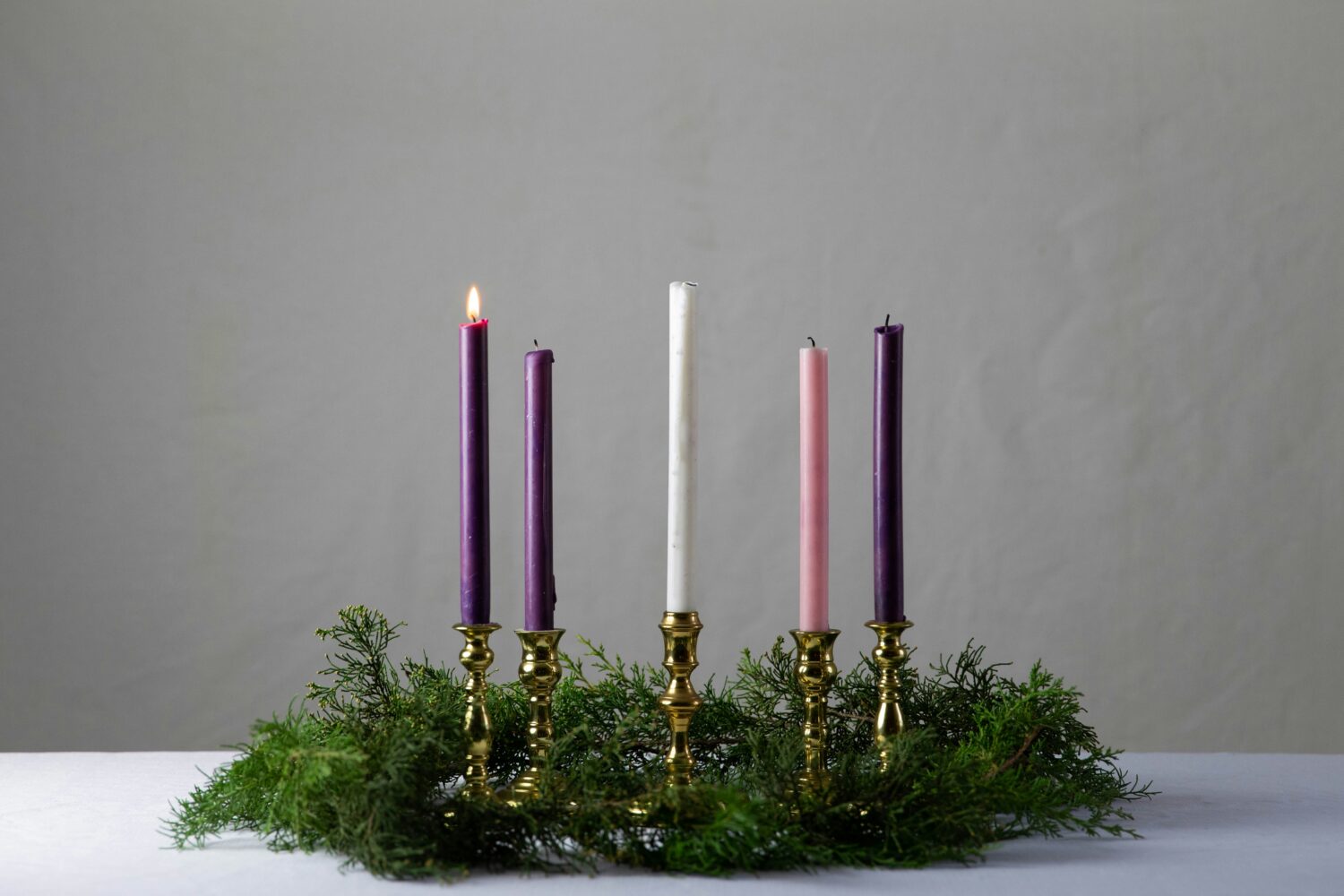
We do have the Advent wreath out again for this year. Thanks to the people who set things like that up! The lighting of the wreath marks the Sundays from now until our Christmas celebration. The readings and the song with the lighting help us focus on the Advent messages. Also, someone has taken down the Thanksgiving decorations. Do you see the blue decorated cloths on the altar, the pulpit and the lectern [point to each], and that my stole is also blue? Yes, the green and white cloths from recent weeks have now been changed to blue.
Blue. Have you ever watched the sun rise? It can be pretty, right? Have you ever watched the sky turning from black to blue before the sun rises in the morning? You have to get up pretty early to see that, especially in the summer, but in the winter, not so much. The blue sky before dawn, before the sun rises, is a sign of the certainty of the beginning of a new day. In a similar way, our hope for the return of Jesus in glory is a hope as certain as the blue before dawn. The blue in the season of Advent, in cloths, stoles and candles connects to the blue before dawn to remind us of Jesus’ Coming.
Did you know that the name for this season, Advent, is from a Latin word that means “coming”? In Advent we look forward to the celebration of the 1st Coming of Jesus in the flesh, the celebration we call Christmas. In Advent we also look forward to the final Coming of Jesus at the end of all things, his Coming in glory. We also trust that Jesus comes to us now in the Communion and in Baptism. We trust that Jesus comes to us now in the scriptures as we hear and study and pray with them. We trust that Jesus comes to us now in worship and prayer, in the needs of our neighbors, in our fellowship together…and more. Let’s pray: “God thank you for the beauty of the night sky, for the beauty as the black sky at night turns to blue, and for the beauty of a sunrise. Thank you for the food and fun many of us shared during Thanksgiving gatherings this week. Thank you for sending your Son, Jesus to live among us, give his life for us, and to share his life with us, now and forever. Thank you for the hope we have in the Coming of Jesus at the end of all things. Amen
Note #2: I have included here some comments that I have shared before reading the Gospel text for this week. Another person might choose to include them as I did, or move them into the sermon itself, or not include them at all.
Comments before reading the Gospel text:
- As we hear today’s Gospel text, we are in Chapter 13, near the end of Mark’s Gospel. With chapter 14, the Passion narrative begins. This is a series of stories about the last days of Jesus’ life – his betrayal, arrest, crucifixion, death and burial.
- Chapter 13 begins with Jesus and disciples walking around and looking at the magnificent temple in Jerusalem. The disciples marvel. However, Jesus says, “Do you see these great buildings? Not one stone will be left here upon another; all will be thrown down.”
- Next, we find Jesus and some disciples on the top of Mount Olive, overlooking the Jerusalem temple. In response to Jesus’ words, disciples ask, “Tell us, when will this be, and what will be the sign that all these things are about to be accomplished?” Jesus’ answer to their questions, when and what will be the sign, takes up the rest of the chapter. Jesus doesn’t answer the “when” question directly. He does say things like, “There will be false leaders, don’t follow them.” Jesus also talks about other signs, like wars, famines, earthquakes and persecutions, but quickly adds that these are NOT signs of the end. He only says that these things are only “the birth pangs.” That is, the “end” will be happening, but not yet. This is where today’s reading now picks up.
Grace, mercy, and peace to you from God our Father and the Lord Jesus Christ. Amen.
So, what about the questions of those disciples, “When will this be?” and “What will be the sign?” As our text begins today, Jesus says, “But in those days, after that suffering,” – the suffering is the persecution, the wars, famines and the like. Those things are the “birth pangs” to use Jesus’ image, which is another word to describe a woman in labor. To continue beyond Jesus immediate image, we could say that what follows the birth pangs, what follows the labor, is the delivery of the child. In today’s reading, Jesus says of those days, “the sun will be darkened, and the moon will not give its light, and the stars will be falling from heaven, and the powers in the heavens will be shaken. Then they will see ‘the Son of Man coming in clouds’ with great power and glory.” With signs like that nobody will miss it! No one will miss the actual signs of the coming of the Son of Man. I would note for you, if anyone thinks that they need to explain any signs of Jesus’ return, run the other way. The signs Jesus speaks about no one will miss!
After speaking about the Son of Man coming in the clouds, Jesus adds a saying about a fig tree. He says to learn its lesson, “as soon as its branch becomes tender and puts forth its leaves, you know that summer is near.” I think what he means is that when the sun is darkened, when the moon turns to blood, when the stars fall from heaven you will KNOW that the Son of Man will be coming. Indeed, Jesus says, “So also, when you see these things taking place, you know that he is near, at the very gates.” Jesus seems to calmly add something like, “When the end is coming you will not miss it.”
But, when? When? WHEN? You know what Jesus added, “But about that day or hour no one knows, neither the angels in heaven nor the Son, but only the Father.” Not knowing is what we have to live with. Period. Some time ago, I read a Hasidic story about a rabbi.1 This rabbi crossed a Russian village square every morning on his way to the local synagogue to pray. One day, a large Russian Cossack soldier demanded, “Hey rabbi, where are you going?” The rabbi simply said, “I don’t know.” This angered the soldier, so he said, “What do you mean, you don’t know? Every morning for twenty-five years you have crossed the village square and gone to the synagogue to pray. Don’t fool with me. Why are you telling me you don’t know?” Then, he grabbed the rabbi by the coat and dragged him off to jail. Just as the soldier was about to push him into the cell, the rabbi turned to him, and softly said, “You see, I didn’t know.”
We might as well get used to it, too. We don’t know the time of Jesus’ return and we can’t know it! However, that’s not all Jesus had to say. In the last four verses at least three times he says, “Watch” or “Keep Alert.” He tells a mini-parable about a man who was going on a journey. He leaves and puts his slaves in charge, each with his own work…and he commands the doorkeeper to be on the watch. Two things while he was gone – they were to work and watch. Today, each one of us has a life’s work to do AND we are to keep watch, not knowing when Jesus will return. Our life’s work is not just a job or our station in a family – as a child, parent, grandparent or whatever. Our life’s work is to serve God and our neighbor in the midst of jobs – at the store, on the farm, at school, in the factory, in retirement. Our life’s work is also to serve God and our neighbor in the midst of family, whether we are younger or older, parent or child, aunt or uncle, niece, nephew, grandchild or whatever.
Often when we hear, “Keep your eye on the ball,” It is heard in sports settings. It is about focus or attention. “Keep your eye on the ball” we say to a batter in baseball. “Keep your eye on the ball” and let go of the crowd, the fielders, even the pitcher. We use the phrase “Keep your eye on the ball” in pickleball, volleyball and other sports, too. When Jesus says, “Watch…Keep Alert” he means something like “Keep your eye on the ball.” In the midst of jobs and family, keep your eye on God’s work. Participating in God’s work is your life’s work.
Two things, work and watch. While we keep our eye on the ball, while we keep our eye on participating in God’s work in the present, we also watch for the return of Christ. But, we might ask, “Why watch anyway? Why watch for the return of the Son of Man at all?” Watching draws us more deeply into our hope for the Coming of the Son of Man, and it draws us closer to participating in God’s work now.
Have you ever heard of multi-tasking? That’s when someone does several things at one time. Well, if I am correct, we really can’t multi-task. That’s why texting and driving doesn’t work. We end up distracted from the important task of driving – of “keeping our eye on the road,” so to speak. However, we can do many tasks, one at a time in succession…sometimes in quick succession so that it seems like multi-tasking. Jesus says, work and watch. So, we might protest and say that we can’t work and watch at the same time. We might protest that to work and to watch at the same time seems like multi-tasking…which we cannot do. However, it is a gift of God that work and watch go together! As we work, we watch for the Coming of the Son today…and at the end of all things.
As surely as the blue sky before dawn signals the rising of the sun, so also the word of scripture signals the sure return of the Son of man. So, watch. The return of the Son of Man in Glory, the gathering of God’s own from the ends of the earth by the angels – this is good news. This is good news because the end is God, the end is certain. …. Keep your eye on the ball; keep your eye on God’s work in midst of job and family. At the same time, keep your eye on the horizon, keep alert to the Coming of the Son of Man.
Amen.
In the name of the Father, and of the +Son, and of the Holy Spirit. Amen.
Pr. Luther H. Thoresen, ELCA, STS, retired thoresenluther54@gmail.com Grundy Center, IA, USA
1 This illustration was from King Duncan’s, Collected Sermons on wwww.Sermons.com, but I received it in the early 2000’s as part of a weekly Email of sermon illustrations from Brett Blair.