
Matthew 14: 22-33
ELEVENTH SUNDAY AFTER PENTECOST | AUGUST 9, 2026 | A Sermon based on Matthew 14: 22-33 (RCL) | by David Zersen
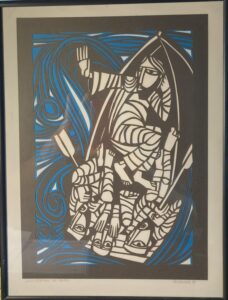
Immediately he made the disciples get into the boat and go on ahead to the other side, while he dismissed the crowds. 23And after he had dismissed the crowds, he went up the mountain by himself to pray. When evening came, he was there alone, 24but by this time the boat, battered by the waves, was far from the land, for the wind was against them. 25And early in the morning he came walking toward them on the sea. 26But when the disciples saw him walking on the sea, they were terrified, saying, “It is a ghost!” And they cried out in fear. 27But immediately Jesus spoke to them and said, “Take heart, it is I; do not be afraid.” 28Peter answered him, “Lord, if it is you, command me to come to you on the water.” 29He said, “Come.” So, Peter got out of the boat, started walking on the water, and came toward Jesus. 30But when he noticed the strong wind, he became frightened, and beginning to sink, he cried out, “Lord, save me!” 31Jesus immediately reached out his hand and caught him, saying to him, “You of little faith, why did you doubt?” 32When they got into the boat, the wind ceased. 33And those in the boat worshiped him, saying, “Truly you are the Son of God.”
TAKE A STEP FORWARD
I never swam in the Sea of Galilee, and I certainly never got re-baptized in it, as I’ve seen well-meaning Christians do, thinking it might be cool, given that it’s Galilee and all! But it is a remarkable setting, and travelers who go there reflect on the Jesus stories that took place there with awe. The Sea itself is 700 feet below sea level, in a deep basin, surrounded by hills, and is thirteen miles long. Downdrafts of cold winds on warm water can create violent turbulence, wind funnels that make six-foot-high waves! Imagine a modern swimmer caught off guard in a storm. It would be interesting to research how many people through the centuries have drowned in a storm at that Sea, if only there were records to check. In a recent year, I read, there were at least seven drownings. And over thousands of years, in that small lake, perhaps thousands!
Peter, Jesus’ disciple, knew what we’re talking about. He had often been on the Sea fishing, when suddenly a storm came up. Rembrandt van Rijn, having never been to Galilee and never having painted a seascape before, painted the scene in 1633, and fortunately there is a photograph of it. It was stolen in 1990 from a Boston museum along with twelve other paintings worth $500 million. The museum is offering $12 million to have it returned in case you’re interested, but one theory is that the Boston mob is involved and it may likely never be returned! But I digress.
Numerous biblical stories take place around water, and, specifically, around the Sea of Galilee. It is a setting for fishing success, as well as failure, a port from which to escape crowds in a boat, and a place to have your faith tested, whether the boat is engulfed by a storm or whether you are being invited by Jesus to walk on water! Something is intriguing about that phrase, and many are the vocal artists who have composed and sung songs about it. Neil Diamond, Eminem, Beyoncé, Eddie Money, Marc Cohn, and others have sung about it- usually addressing a situation in which one is being called to take a step forward even when you aren’t sure it makes sense.
Evaluating Your Fear
All of us know this moment very well. It may not involve water, but it typically involves some kind of fear, disappointment, or sorrow that seems to preclude taking a step forward. In any case, the “storm” with which you’re wrestling doesn’t allow you to remain the person you were before. It can involve your attitude toward another, your acceptance of a political position, or your rejection of something you’ve accepted for years. In the case of a Christian, it may have to do with a crisis of faith. One of the reasons that the Bible is so “real” is that it is filled with stories of people who lost their way or abandoned their faith. They typically use a crisis as a moment to surrender the confidence they would have used to move forward. Peter learned this when Jesus asked him to join him outside the boat. A recent conversation I had with a friend showed that he found himself to be in the same predicament. As we talked about his ties with the church, he explained that when his two daughters were dying and his wife was dying, he had prayed fervently for their recovery. He was afraid of a future without them. So, instead of evaluating how God might help him move into a whole new kind of future, he concluded that he was being called to abandon his faith, reject any future with God, and leave the church. Period!
We know this “storm” very well, and the Bible and literature in general dwell on it because it is a typical stance for humans. Judas may have refused to move forward with God because of embarrassment, not being able to return the betrayal money, and Peter may have refused to face the possibility of being captured when he denied he knew Jesus. But what about Ananias and Saphira, who were afraid that being found out would end their future? What about Jacob, who was afraid to accept a future that his brother Esau might control? What about Cain, who couldn’t understand how a future with Abel might make sense? The list of biblical names, many of whom overcame their fears but wallowed in them long enough for us to name them kindred spirits, is long. We have been there too, the times when we wondered if there could be a future if things didn’t go our way.
Although there is some fear on my part in making the list too long, I think it’s valuable to remember that the great storytellers in our history have also captured this moment all too well. Some of our favorite novels are real to us because some of the characters remind us of ourselves. Some characters trembled at the temptations or the travesty and surrendered all. In one of my favorite novels, Silence, by Shusaku Endo, a priest is appalled by the seeming silent indifference of God as peasants are tortured, so he finally felt forced to trample on a sacred image and abandon the faith. In Flannery O’Connor’s great Wise Blood, Hazel Motes returns from war, drained of any support for a concept like a loving God, so he founds a “Church Without Christ.” He allowed his fear to negate anything that he had previously cherished. He felt he couldn’t walk on water, so he sank.
Contemplating Hope
Such characters, whether biblical or literary, are real to us, because we can see ourselves in them. We have all been faced with challenges, and we have all felt like surrendering. Peter is real to us because he knew the Sea of Galilee, he knew people had drowned there, and he wasn’t sure he could take another step forward. It’s always that way when the future looks dark. However, in biblical and secular literature there are many positive examples of people who didn’t throw away the future, but decided to venture forward in hope and confidence.
In the most current version of a novel put on screen, there is the challenge faced by Penelope in Nolen’s version of Homer’s The Odyssey. Loyal to Odysseus, even though he’s gone for 20 Years!!!, she wards off aggressive suitors who offer a positive future and remains true to her commitment. In a favorite of mine, Graham Greene’s The Power and the Glory, the “Whisky Priest” surreptitiously, although a drunkard and a philanderer, continues to serve God’s people during the clerical purges of late 1920s Mexico. He’s a creative example of how a person evaluated his fear of the future and moved ahead on his own terms. He kept the faith, although in a controversial way.
I remember a fellow student in Germany who once told me that he wanted nothing to do with Christianity, because if God was anything like his father, the notion of a “Father God” was abhorrent to him. All of us know such stories about people who rejected a Christian future because there were words and names and concepts with which they had had bad experiences.
Yet don’t we find it fascinating that the Jewish people shaped a civilization on flawed people who nevertheless found it possible to live in hope rather than fear? David, Noah, Abraham, Isaac, Jacob, and so many others all had reason to leave nothing for us but a bad example, a dead-end personality that doesn’t encourage imitation. Despite that reality, they were able to set aside their fear and step forward in faith, proving that no matter what the past, the future can be an open door.
At the heart of it, no matter what negative or painful experiences you may have had, this is precisely why we have a Christian faith. It is the very faith that some have found easy to reject because trouble in life has made it difficult to take a step forward. Jesus knows exactly what it is to feel abandoned, rejected, left without a future. The essence of crucifixion said to Jesus, and to all of us, this is what abandonment truly feels like. In Kazantzakis’s Last Temptation of Christ, we are helped to know through Jesus’ experience that one can feel abandoned. To feel that “this is it”. It’s all just a dead end. “My God, My God, why have you forsaken me”? (Ps. 22:1)
Yet the essence of the Christian story is that this was not a dead end but a new beginning for Jesus and for all of us who often feel abandoned. Not today. Not ever. God proves that in the resurrection of Jesus. The essence of God’s loving plan is grace, a future, and an open door. We may live in hope, not fear. We may take the next step, no matter what. We walk by faith, not by sight.
Christians like you and me are people who trust that God loves and accepts them, forgives and frees them, in and through the crucifixion and resurrection of Jesus. This is good news. It is the Gospel we live by. It is the essence of positive, futuristic thinking to know and trust this. No matter what seems to be a dead end, a closed door, or a scary trial, take a step forward.
Be people of confident faith, undying hope, transforming love.
Celebrate being Christian.
Hymn: “My Hope is Based on Nothing Less”
—
David Zersen, D.Min, Ed.D., FRHistS
President Emeritus, Concordia University Texas
zersendj@gmail.com
414 727 3890